



When my neurodegenerative disease began to take things from me, it didn’t do so loudly or all at once. It arrived in quiet increments—first stamina, then clarity, and eventually my most familiar companion: my voice. For someone who had spent a career as a sales and practice consultant, conversation was never just small talk. It was connection, influence, problem-solving, and purpose. Losing the ability to easily contribute to conversations felt less like a symptom and more like an erasure of identity.
What I did not expect—and what this journey has taught me is that even as some doors close, others open in ways you could never predict.
As my speech declined, frustration grew. Wanting to speak and not being able to feels like being trapped behind glass—present, aware, but unheard. Through Johns Hopkins, I was introduced to a resource I hadn’t known existed: Bridging Voice. That introduction marked a turning point, not just in how I communicate, but in how I see what is still possible.
Bridging Voices didn’t treat my situation as a limitation to be managed. They treated it as a challenge to be solved—with creativity, dignity, and deep humanity. Through them, I was introduced to the Talk To Me speech-generating device, powered by eye‑gaze technology. Suddenly, my eyes became my voice. By simply looking, I could select stored phrases or spell out exactly what I wanted to say, word by word.
That might sound like technology—but what it really gave me back was participation. I could rejoin conversations. I could clarify, contribute, joke, disagree, and engage. I wasn’t just “there” anymore. I was present again.
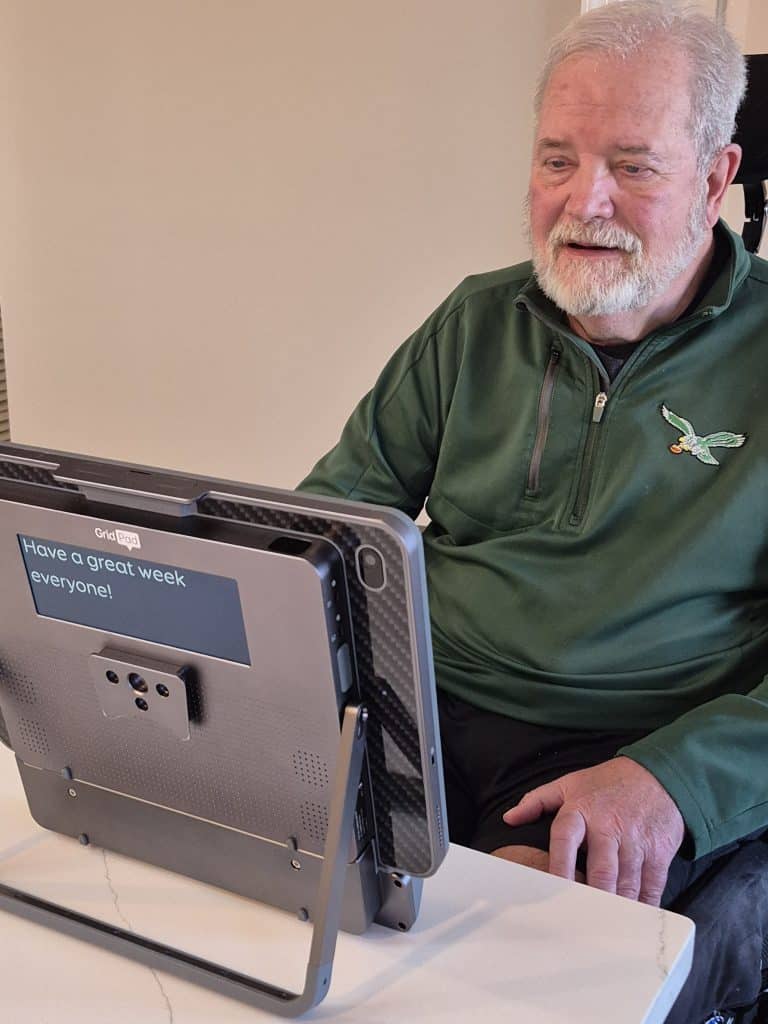
The device didn’t stop at speech. I discovered I could use it to surf the web, open Facebook, watch YouTube, or listen to Spotify. These may seem like small things, but when your world starts to narrow, these moments of independence mean everything. They are reminders that curiosity, joy, and agency don’t disappear just because your body is changing.
Bridging Voices continued to walk beside me, connecting dots I didn’t even know existed. Through them, I learned about Team Gleason, an organization doing incredible work to ensure people like me can access the technology we need, especially when funding might otherwise be a barrier. Their support reinforced something important: I am not navigating this alone, and neither are countless others facing similar diagnoses.
Then came something I never imagined possible.
Bridging Voices introduced me to ElevenLabs, a company using AI in a way that feels nothing short of miraculous. Using recordings of my voice from over twenty years ago, they were able to create a digital version of my actual voice. Its tone. Its cadence. Its personality. Now, when my device speaks, it doesn’t sound generic or robotic.
It sounds like me.
There is something profoundly emotional about hearing your own voice speak again, especially when you thought it was gone forever. It restores more than sound. It restores familiarity, recognition, and selfhood. Friends and family don’t just hear words; they hear me, the way they always have.
This journey has not been easy. I won’t pretend otherwise. There are moments of grief for what’s been lost and uncertainty about what’s ahead. But there is also deep gratitude—for medical teams who listen, for innovators who imagine better futures, for organizations that bridge gaps, and for people who believe that communication is a basic human right.
I didn’t know these resources existed. I didn’t know this level of support was possible. And now, because of Johns Hopkins, Bridging Voices, Team Gleason, Talk To Me, and ElevenLabs, I am living proof that even as a voice fades, it doesn’t have to disappear.
Sometimes, finding your voice again doesn’t mean reclaiming what was—it means discovering something entirely new.